
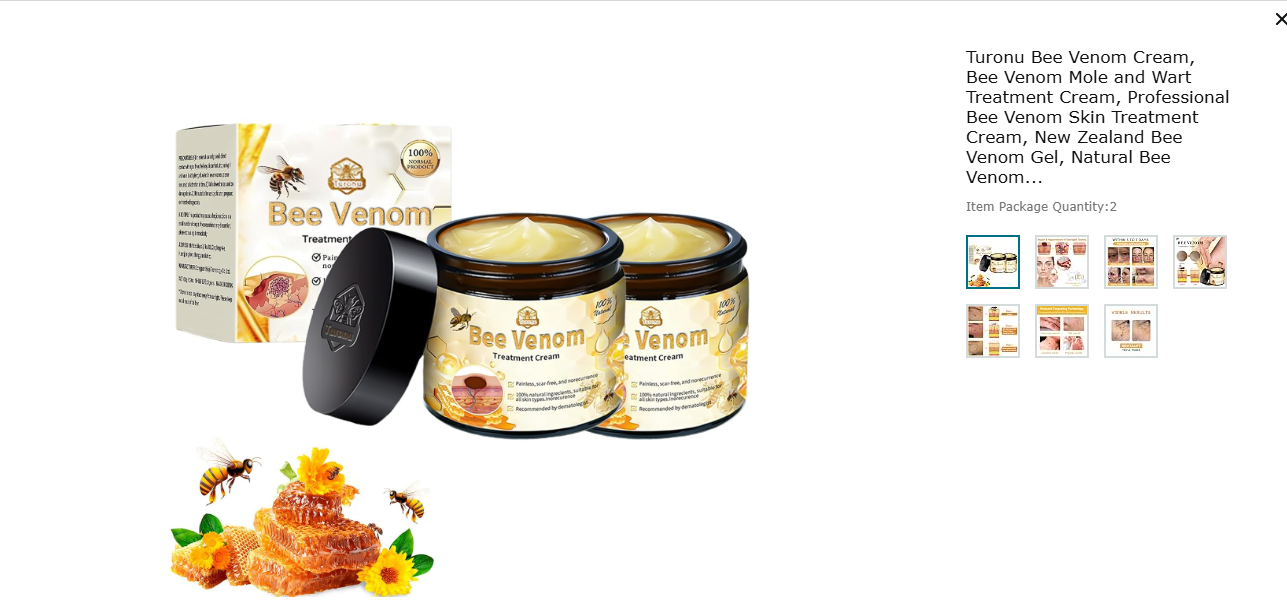
Turonu Bee Venom Cream is an online skincare product marketed as a solution for several skin concerns, including warts, skin tags, moles, acne, eczema, and other skin imperfections. Its advertisements promise fast results and describe the formula as a natural alternative to conventional treatments.
The product may sound appealing to people who want to remove unwanted skin growths at home without visiting a dermatologist. However, claims involving the removal of moles and warts deserve particular scrutiny because an incorrect treatment can irritate or damage the skin and delay the diagnosis of a potentially serious condition.
So, is Turonu Bee Venom Cream legitimate? Do customer reviews support its claims? Is it safe to apply to moles, skin tags, or sensitive skin?
In this Turonu Bee Venom Cream review, we examine the seller’s claims, available customer feedback, ingredient information, scientific research, and important safety considerations.
Our verdict: We could not establish independent evidence that Turonu reliably removes moles, skin tags, or warts within one to two weeks. The product’s broad medical claims and bee-venom allergy risks warrant caution before purchasing or using it.
What Is Turonu Bee Venom Cream?
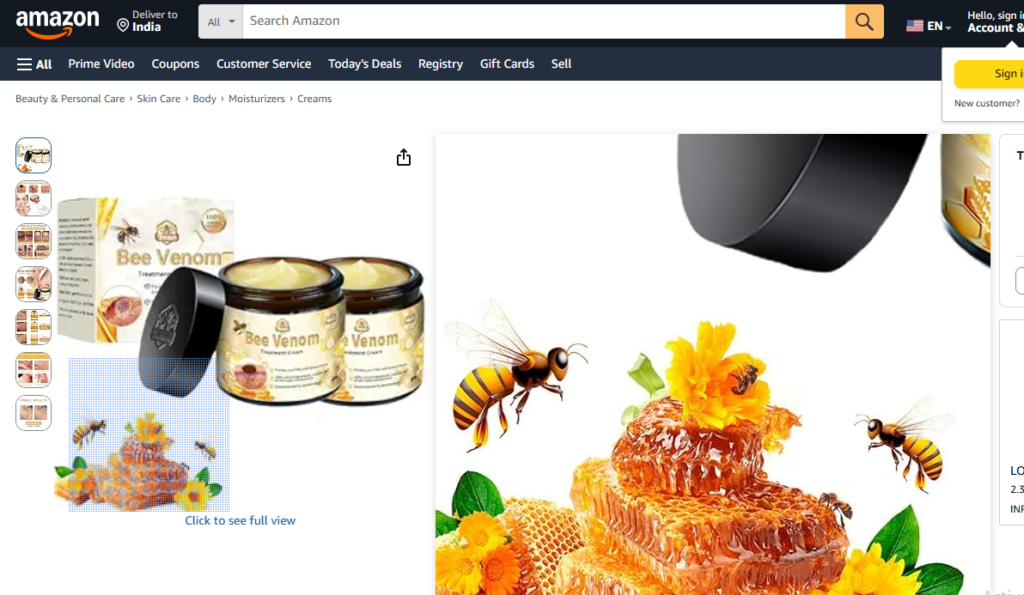
Turonu Bee Venom Cream is marketed as a topical skin-treatment product containing bee venom and other ingredients. The brand promotes it for a range of concerns, from blemishes and skin irritation to moles, warts, and skin tags.
The product appears in multiple listings on the Turonu website, including pages titled Bee Venom Skin Treatment Cream and Bee Venom Treatment Cream.
The seller advertises benefits such as:
- Removing skin tags and warts
- Reducing the appearance of certain skin imperfections
- Supporting skin repair and regeneration
- Improving the appearance of blemishes
- Providing fast results with minimal discomfort
These claims are not all equivalent. A cosmetic cream that moisturizes the skin is different from a treatment intended to destroy or remove a skin growth.
The distinction is important because moles, warts, and skin tags have different causes and may require different approaches. A product should not be assumed to treat all of them simply because its advertising lists multiple conditions.
What Does Turonu Claim About Its Formula?
Turonu’s product pages make extensive claims about the formula’s effectiveness, safety, and clinical testing.
One listing reports that more than 2,000 participants were involved in testing and advertises extremely high satisfaction and success percentages. Another page describes a trial involving 1,542 participants and claims that 95% successfully removed warts and moles within one to two weeks.
However, the product pages reviewed did not provide enough independently verifiable clinical documentation to substantiate these figures. We could not establish the full study protocols, independently verified results, or a published clinical trial demonstrating that the marketed cream safely removes moles and warts at the claimed rate.
The seller also displays claims involving professional endorsements and regulatory certifications. These should be checked directly with the relevant professional organization or regulator rather than accepted solely because they appear on a sales page.
Important: A seller’s use of phrases such as “clinically tested,” “certified,” or “dermatologist approved” is not a substitute for verifiable evidence of the product’s safety and effectiveness for a specific medical use.
Turonu Bee Venom Cream Ingredients
The ingredient information varies across the product pages, so buyers should check the label on the actual product they receive.
1. Bee venom
Bee venom contains biologically active compounds, including melittin and enzymes. Researchers have investigated its potential applications in skincare and certain inflammatory skin conditions.
However, research into bee venom as an ingredient does not establish that Turonu’s finished formula removes moles, skin tags, or warts.
Bee venom also carries a significant safety concern: some people can develop allergic reactions, including severe systemic reactions. The published review Cosmetic Applications of Bee Venom discusses both its potential cosmetic uses and the risks associated with immune reactions.
2. Salicylic acid
One Turonu product page lists 5% salicylic acid. This ingredient is used in various topical products, including certain treatments for common warts.
However, the presence of salicylic acid does not prove that the entire product is appropriate for every skin growth or body area. Treatments intended for common warts should not automatically be used on moles or unidentified growths, especially on the face or near the eyes.
Confirm the exact formulation and intended use before considering any product containing this ingredient.
3. Tea tree oil
Tea tree oil is used in some skincare products. It can also cause irritation or allergic contact dermatitis in some individuals.
Its presence does not establish that the cream can safely remove skin tags or other growths.
4. Other botanical ingredients
Some listings mention additional plant extracts and ingredients intended to support skin conditioning or comfort.
The exact formula and concentrations matter. Because the product pages do not consistently establish a single, independently verified formulation, it is important to check the ingredients printed on the packaging rather than relying on broad marketing descriptions.
What Do Turonu Bee Venom Cream Reviews Say?
Customer feedback about Turonu is mixed across third-party review websites and online discussions.
Some users describe positive experiences, while others report no noticeable improvement, small containers, skin irritation, or dissatisfaction with the purchase.
These accounts are not a representative clinical study, and individual experiences cannot establish how often the product works. Nevertheless, the variation in feedback is relevant when evaluating a product promoted with exceptionally high success claims.
Positive experiences reported online
Some reviewers say they liked the cream or noticed changes in the skin area where they applied it. Other comments describe the product as soothing or moisturizing.
Such experiences may reflect individual differences in skin condition, the product used, or expectations. They do not establish that the cream reliably removes skin growths or treats medical skin conditions.
Negative experiences and complaints
Other reviews raise concerns about:
- No noticeable improvement after repeated application
- Disappointment with the small amount of cream received
- Irritation, redness, or soreness around the treated area
- Uncertainty about how and where to apply the product
- Questions about product consistency and customer service
- Concerns about refund conditions
For example, the review published by Ibisik describes an unsatisfactory personal experience and raises questions about the product’s marketing and customer testimonials.
A separate review on Infoquu discusses concerns about claimed benefits, product similarities, and reported irritation.
These are third-party accounts, not independently verified findings about every purchase. We therefore cannot conclude that all customers will experience the same problems. However, the mixed feedback does not support treating the seller’s high success percentages as established fact.
Does Turonu Bee Venom Cream Really Remove Moles and Skin Tags?
This is one of the most important questions for prospective buyers.
The available evidence reviewed for this article does not establish that Turonu Bee Venom Cream safely and reliably removes moles or skin tags within one to two weeks.
There is also an important medical distinction between a wart, a skin tag, and a mole.
- Warts are commonly caused by certain types of human papillomavirus.
- Skin tags are generally benign skin growths that may be removed using appropriate clinical methods.
- Moles are pigmented growths that may require assessment to determine whether they are harmless.
A product that is appropriate for one type of growth may be unsuitable for another. Attempting to destroy a mole at home can damage the surrounding skin and delay the diagnosis of skin cancer.
The American Academy of Dermatology advises people not to remove moles at home. If a mole is changing in size, shape, or color, or is itching or bleeding, seek professional assessment.
For skin tags or warts, a healthcare professional can confirm what the growth is and recommend a suitable treatment.
Is Turonu Bee Venom Cream Safe?
Safety cannot be established simply because a product is described as natural or contains botanical ingredients.
Bee venom is particularly important because it can trigger allergic reactions in susceptible individuals. Reactions can range from local redness and itching to serious systemic allergy, including anaphylaxis.
A review of bee venom’s cosmetic applications specifically identifies allergic reactions as a significant concern. Clinical research on one bee-venom formulation for a particular skin condition cannot be used to prove that every bee-venom product is safe for every person.
The seller’s assertion that the product is suitable for people allergic to bees should therefore not be relied upon without strong, independently verified safety evidence.
Other potential concerns include irritation from the overall formula and skin damage if an inappropriate product is used to remove a growth.
For safety:
- Do not apply the cream to a mole or unidentified skin growth in an attempt to remove it.
- Avoid use near the eyes, on broken skin, or on sensitive areas unless a qualified healthcare professional confirms that the product is appropriate.
- Do not assume a home patch test can rule out a serious allergic reaction.
- Stop using the product if you develop redness, itching, swelling, burning, or a rash.
- Seek emergency care if you develop symptoms of a severe allergic reaction, such as difficulty breathing or swelling of the tongue or throat.
If you have a history of bee-sting allergy, do not experiment with bee-venom skincare without medical guidance.
Is Turonu Bee Venom Cream Legit or a Scam?
The evidence reviewed does not allow us to conclude that every Turonu purchase is fraudulent. However, there are reasons to approach the product cautiously.
The seller has online product listings and describes the product’s ingredients, prices, and advertised benefits. Yet the existence of a storefront does not prove that the cream works as claimed.
Several points deserve particular attention.
Broad treatment claims
The seller promotes the cream for multiple conditions, including moles, warts, eczema, psoriasis, acne, and other skin concerns. These conditions have different causes and may require different treatments.
Claims that a single cream can resolve such a wide range of conditions quickly need strong clinical evidence.
Very high success percentages
The product pages advertise impressive success and satisfaction rates, but we could not independently verify the underlying clinical data.
Without a published study that can be examined independently, these figures should be treated as seller-reported claims.
Conflicting policy information
Different product pages display different refund information. One page advertises a 180-day unconditional refund, while another describes a 30-day return policy with return shipping paid by the customer.
These terms may relate to different listings or have changed over time, but the discrepancy means buyers should verify the policy that applies to their exact order.
Reviews hosted by the seller
The product pages feature promotional testimonials, but the listings reviewed also displayed zero reviews in their own review sections. This does not prove that the testimonials are fabricated, but it means readers should distinguish between promotional material and independently verified customer reviews.
How to protect yourself before buying?
If you are still considering an order, check the following:
- Seller details: Verify the website address and available business contact information.
- Full ingredient list: Confirm the formulation and intended use from the packaging.
- Clinical claims: Look for published, independently verifiable studies of the exact finished product.
- Regulatory claims: Verify claimed approvals or certifications directly with the organization named.
- Final price: Check the total cost, shipping charges, and currency before payment.
- Refund conditions: Save a copy of the policy that applies at checkout.
- Payment protection: Use a payment method with appropriate dispute-resolution options.
Our assessment: Turonu Bee Venom Cream has not been shown by the evidence reviewed to deliver its most ambitious claims. The uncertainty surrounding effectiveness and safety is particularly important because the product is marketed for removing skin growths.
Turonu Bee Venom Cream: Pros and Cons
Potential advantages
- The product is available through online shopping listings.
- Some customers report positive personal experiences.
- The formula is marketed as containing bee venom and other skincare ingredients.
- The seller advertises refund options, although the applicable terms need verification.
Disadvantages and concerns
- Reliable removal of moles and skin tags has not been independently established.
- The seller’s high success percentages could not be independently verified.
- Bee venom can cause serious allergic reactions.
- Different listings provide inconsistent refund information.
- Customer experiences are mixed.
- Treating unidentified skin growths at home can delay necessary medical assessment.
What Is the Safer Alternative?
The safest approach depends on the skin concern you want to address.
For a mole, consult a dermatologist before attempting removal. The clinician can examine it and determine whether further testing or removal is appropriate.
For a suspected skin tag, a healthcare professional can confirm the diagnosis and discuss suitable removal methods.
For a suspected wart, a pharmacist or clinician can recommend an appropriate treatment after considering its location and appearance. Do not use a product intended for common warts on an unidentified mole or near the eyes.
For eczema, acne, or persistent inflammation, choose treatment based on the actual condition rather than relying on a cream marketed as a universal remedy.
This approach may require more effort than ordering an online product, but it avoids treating different skin conditions as though they all have the same cause.
Frequently Asked Questions
1. Is Turonu Bee Venom Cream legit?
Turonu has online product listings, but this does not establish that the product is effective for all the conditions advertised. The evidence reviewed does not independently verify its broad treatment claims.
2. Does Turonu Bee Venom Cream remove moles?
We could not establish reliable independent evidence that it safely removes moles. Do not attempt home mole removal with this or another unverified cream. Have a dermatologist assess the mole first.
3. Can Turonu remove skin tags within seven days?
The seller advertises rapid results, but the claimed timeline has not been independently established for the finished product. A healthcare professional can confirm whether a growth is a skin tag and advise on appropriate removal.
4. Can people allergic to bees use Turonu Bee Venom Cream?
Do not rely on the seller’s broad safety claim. Bee venom can cause allergic reactions, including anaphylaxis. People with a bee-venom or bee-sting allergy should seek medical advice before considering exposure to a bee-venom product.
5. Are Turonu Bee Venom Cream reviews positive?
Online feedback is mixed. Some users describe positive experiences, while others report no improvement, irritation, or dissatisfaction. These reviews do not establish a reliable success rate.
6. Does Turonu offer a money-back guarantee?
The seller advertises refund guarantees, but different pages describe different time frames and conditions. Confirm the exact policy that applies to your order before paying.
7. Is Turonu Bee Venom Cream worth buying?
Given the limited independent evidence for its advertised benefits and the potential safety concerns, we would not recommend relying on it to remove moles, skin tags, or other growths. A qualified healthcare professional can help identify a safer and more appropriate treatment.
Final Verdict:
Turonu Bee Venom Cream is marketed as an all-purpose skin treatment with claims involving moles, warts, skin tags, acne, eczema, and other concerns. Its advertising features high success percentages and promises of quick results, but the underlying evidence could not be independently verified.
The scientific literature does explore potential cosmetic and therapeutic applications of bee venom. However, that research does not establish that Turonu’s finished formula can safely remove moles or skin tags in one to two weeks.
The product also raises safety questions because bee venom can cause serious allergic reactions, and the seller’s pages present inconsistent refund terms.
Our conclusion: Approach Turonu Bee Venom Cream with caution. Do not use it for DIY mole removal or assume it is a proven treatment for medical skin conditions. Verify the product and seller carefully, and consult a qualified healthcare professional before treating an unidentified skin growth.
Editorial disclosure: This review is based on publicly available product information, published research, and third-party reports. We have not independently tested the cream or verified individual customer testimonials and seller-reported clinical figures. Product formulations and website policies may change.
Also, Check: Furzero Silicone Denture Set Review
1 thought on “Turonu Bee Venom Cream Review: Effective Or Not? ”